Tiger Stripes on Your Gutters: What They Are and How to Get Them Off
Those black vertical streaks on your gutter faces aren't dirt — they're bonded oxidation a hose won't touch. Here's what causes tiger striping and how gutter brightening actually removes it.
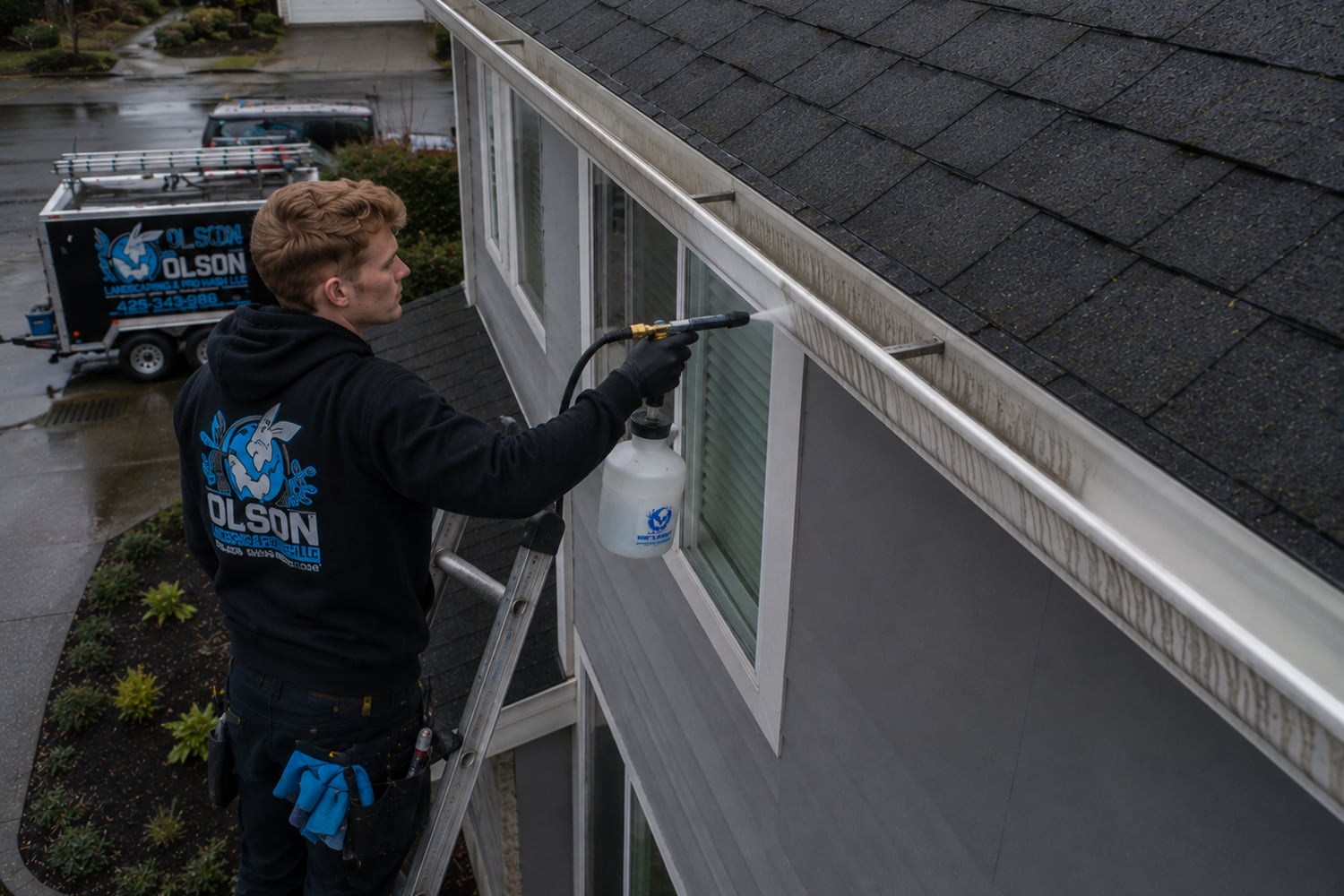
You had the gutters cleaned, the downspouts flow fine, and the roof looks great — but the gutters still look dirty from the street. Long black vertical streaks run down the front face of every run, worst under the valleys and roof edges. That’s tiger striping, and it’s the single most common thing homeowners around Lake Stevens ask us to fix after a house wash.
What tiger stripes actually are
They are not loose dirt, and they are not mold. Every time it rains, water sheets off the roof carrying a fine mix of asphalt-shingle residue, roof grit, pollen and airborne pollutant fallout. That slurry runs over the lip of the gutter and down the outside face. The water evaporates; the residue stays. Over months and years it oxidizes and bonds to the painted finish in a striped pattern that follows the drip lines — hence “tiger stripes.”
Because it’s a bonded film rather than surface grime, the usual tools do nothing:
- A garden hose or pressure washer just sheets water over it. You can stand there for ten minutes and watch the stripes not move.
- A regular gutter cleaning clears the inside of the trough — leaves, needle sludge, downspout clogs. It was never meant to touch the outside face, so a freshly cleaned gutter can still be covered in stripes.
- Scrubbing by hand with dish soap lightens them slightly and takes forever, and you’ll usually leave swirl marks or miss the high sections you can’t reach safely.
Why they come back if you ignore them
The stripes are a symptom of runoff, so they keep forming as long as the roof sheds water — which is always. Homes that stripe fastest have older asphalt roofs shedding more granule, sit under heavy tree cover, or are on busier roads where there’s more road film in the air. The longer the oxidation sits, the harder it bonds, so a set of stripes that’s one season old comes off far easier than one that’s been baking on for five years.
How gutter brightening removes them
Gutter brightening is a dedicated detergent process, not pressure washing. On our jobs it runs like this:
- Protect below. Siding, plants and walkways under the run get wetted down and covered so the cleaner can’t dry on anything it shouldn’t.
- Apply the brightener. A gutter-specific detergent goes onto the faces and end caps and is left to dwell — it needs a few minutes to break the bond between the oxidized film and the paint.
- Agitate the heavy sections. The worst stripes under the valleys get worked by hand with a soft brush while the detergent is active.
- Rinse and check. The whole line is rinsed at low pressure — enough to carry the dissolved film away, gentle enough to leave the factory finish intact — then we walk it and re-treat anything that held on.
Most single-family homes take an hour or two depending on linear footage and how set-in the staining is.
The honest limit
If your gutters are very old and chalky, the paint itself may already be oxidized and sun-faded under the stripes. Brightening will pull the black streaking off, but the finish underneath can still look dull or uneven — it can’t restore paint that’s gone. We’ll tell you that after a look rather than promising showroom-white on a 20-year-old gutter.
When to have it done
Gutter brightening is most cost-effective bundled with work we’re already set up for:
- With a house wash — the gutters are the one part a house wash skips, so adding brightening finishes the job.
- With a gutter cleaning — inside and outside handled in the same visit.
- With a roof soft wash — clean the roof, then brighten the faces the roof runoff has been staining.
As a stand-alone visit it runs a little more because it’s a dedicated trip. Either way, pricing is by linear footage and stain severity — most homes land between $79 and $225. On a busy road or under an older roof, a light re-do every couple of years keeps them sharp.
Bottom line
Tiger stripes are bonded oxidation from roof runoff, not dirt — which is why they survive a cleaning and a pressure washer. A detergent-based gutter brightening is what actually takes them off, and it’s the difference between a house that looks clean and a house that looks almost clean.
Not sure how bad yours are? Send a photo of the gutter face and we’ll tell you whether it’s a quick brighten or a heavier re-do — and what it’d cost bundled with your next wash.