Why We Install Raptor Stainless Steel Gutter Guards in the Pacific Northwest
Fir needles, roof grit and nine months of rain break most gutter guards. Here is why Olson Pro Wash installs Raptor Type 304 stainless micro-mesh — and how it holds up here.
Around Lake Stevens, an open gutter is a part-time job. Fir and cedar needles knit into a mat, maple seeds and blossoms pile up in spring, and roof grit washes down all winter. Most gutter “protection” on the market can’t handle that combination. After trying the usual options, the one we now put on customers’ homes is Raptor stainless steel micro-mesh — and here is the reasoning.
The three ways gutter guards fail here
Foam inserts. They fill the gutter with a sponge. Fine debris and pollen work into the foam, it stays wet, and within a year or two you have moss and weeds growing in your gutter. In a damp climate they are a maintenance headache, not a solution.
Reverse-curve (“helmet”) systems. These rely on surface tension to pull water around a curved nose and into a slot. In a light rain they work. In a Pacific Northwest downpour, water shoots straight past the nose and over the front — and the open slot still lets in needles and grit. They also bolt to the roof, which can void a shingle warranty.
Plastic and aluminum screens. The holes are far too big to stop fir needles. They keep out maple leaves and tennis balls; everything finer sifts right through and packs the trough anyway.
What Raptor is
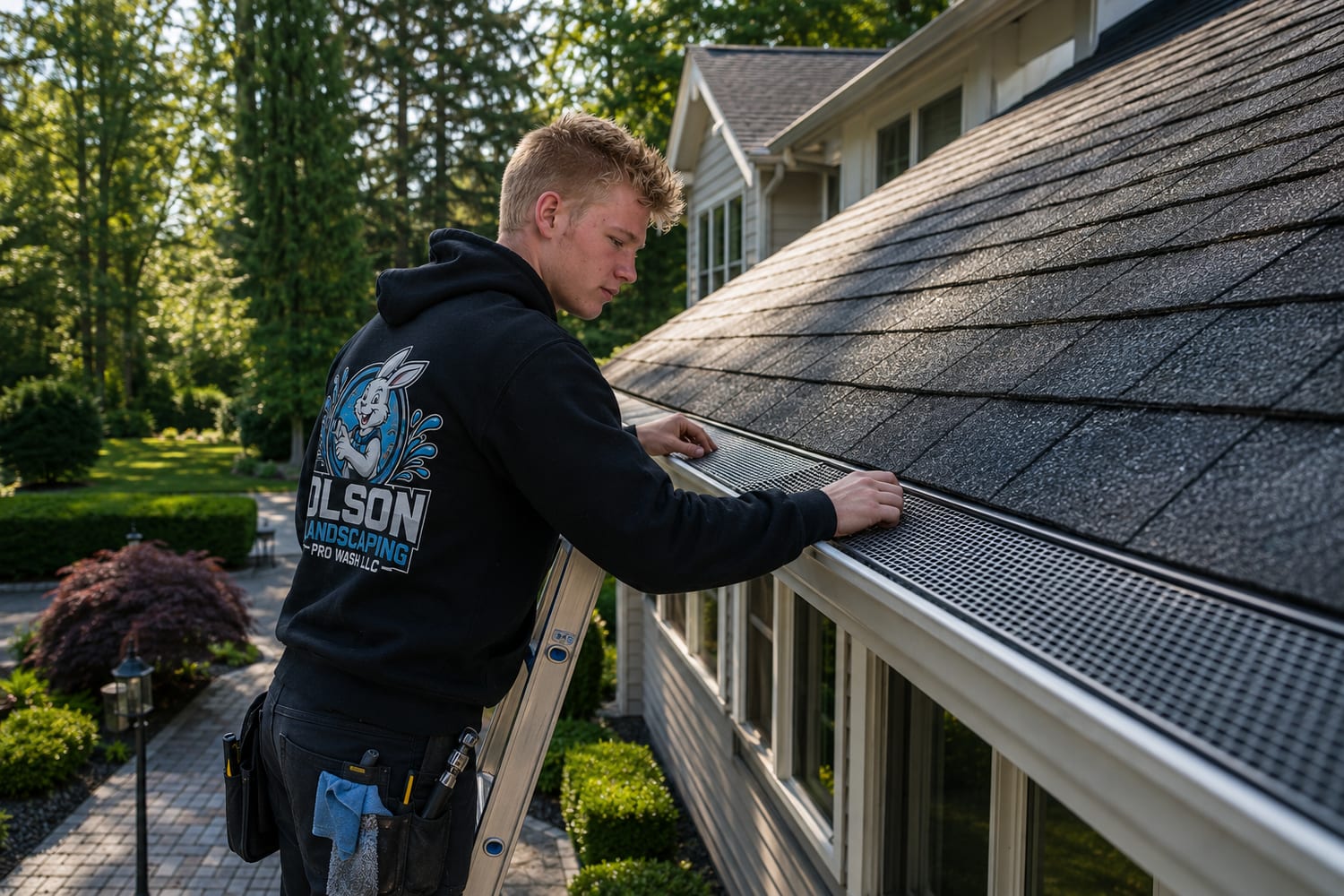
Raptor is a contractor-grade micro-mesh guard. The filtering surface is a Type 304 stainless steel mesh with roughly 900 openings per square inch, set into an aluminum frame with a patented raised V-bend down the length of each panel.
| Feature | Spec | Why it matters here |
|---|---|---|
| Mesh material | Type 304 stainless steel | Rustproof — handles Puget Sound marine air and roof-grit abrasion |
| Mesh density | ~900 openings per sq. in. | Fine enough to stop fir needles, seed pods and shingle grit |
| Frame | Aluminum with patented V-bend | Stiffens the mesh so it carries snow load without sagging |
| Front edge | Patented trough / lip | Pulls water off the mesh and into the gutter in heavy rain |
| Fasteners | Stainless self-tapping screws | Screwed to the gutter, not stapled or glued |
| Warranty | 25-year manufacturer warranty | Backed for the long haul; we add our workmanship guarantee |
The V-bend does two jobs. It adds rigidity so the panel doesn’t oil-can or sag between hangers, and it keeps flat debris — leaves, blossom, needle mats — from lying flush against the mesh where it can seal off water. Debris that lands on Raptor tends to dry out, get light, and blow or wash off.
Does micro-mesh really keep up with our rain?
This is the first question every customer asks, and it’s a fair one. The short answer: yes, because the mesh has far more open area than the gutter itself can carry away. Even when part of the surface is covered with debris, the remaining mesh passes more water than the downspouts can drain.
The failure mode people worry about — water sheeting over the front edge in a hard rain — is a reverse-curve problem, not a micro-mesh one. Raptor’s front trough is shaped to grab that sheet of water and turn it down into the gutter. In our experience on real Snohomish County roofs, through real November storms, it stays ahead of the water.
How we install it
Raptor is sold as a DIY product, and a handy homeowner can absolutely do it. What a professional install buys you is the prep and the finish:
- Assess and measure. We check gutter condition, slope, fascia and downspouts, and flag any rotten or pulled-away sections before quoting.
- Clean and re-pitch. Existing gutters are hand-cleared, flushed, re-sealed at the seams and re-pitched toward the downspouts. Guards on top of a gutter that doesn’t drain just hide the problem.
- Install the Raptor guard. Panels are cut to length, lapped at the seams, trimmed to the roofline and fastened with Raptor’s stainless screws — never staples, never adhesive-only.
- Flow test. We run water across every run and confirm full flow through each downspout before we pack up.
It’s a one-visit job on most homes, and it bundles well with a roof soft wash — you don’t want years of loosened moss washing onto brand-new guards.
What changes after install
You stop cleaning your gutters twice a year. That’s the point.
You’re not completely hands-off forever — over several years, fine dust and pollen can build a thin film on top of the mesh, and a quick rinse from a ladder or a soft wash clears it. But the annual ritual of scooping wet needle sludge out of a trough in the rain is done.
Is it right for your house?
Raptor is a strong fit if you have:
- Conifers anywhere near the roofline — the needle problem is exactly what micro-mesh solves
- A structurally sound gutter system we can clean and re-pitch
- A shingle, metal or standing-seam roof — we fasten it appropriately for each
It’s less of a fit if your gutters are already rusted through or pulling off the fascia — in that case we’ll quote gutter replacement first and show you photos of why.
If you’re in Lake Stevens, Everett, Snohomish, Monroe, Granite Falls or anywhere across Snohomish and North King County and you’re tired of the ladder, send us photos of your gutters and roofline — we’ll come measure and give you a firm per-foot number on Raptor.
Sources: manufacturer specifications from raptorgutterguard.com; independent testing and review by This Old House and RoofCalc.org.